CGPA TO
PERCENTAGE
CALCULATOR
Convert your CGPA instantly using accurate, university-approved formulas for all grading scales.
Why Students Choose Us
No sign-up required. Just fast, accurate results using university-approved formulas.
Instant Results
Type your CGPA and get your percentage live — no button click needed. Calculation happens as you type.
Zero delayCorrect Formulas
Standard CBSE formula (×9.5) for 10-point scale. Accurate formulas for 5-point and 4-point scales too.
Formula shown on resultWorks on Any Device
Fully responsive on mobile, tablet, and desktop. Built for students checking results on their phone.
Mobile firstUnderstanding CGPA to Percentage Conversion
A CGPA to Percentage Calculator helps students quickly convert their CGPA into a percentage using the appropriate conversion formula. It provides fast and accurate results, making it useful for university admissions, job applications, scholarships, and academic evaluations. Since conversion methods may vary between institutions, students should always follow their university’s official guidelines for the most accurate percentage calculation.
What is CGPA and How Does It Work?

CGPA (Cumulative Grade Point Average) is a grading method used to evaluate a student’s academic performance over a semester, year, or complete academic program. Instead of showing exact marks or percentages, institutions assign grade points based on performance in each subject. The average of these grade points becomes your CGPA.
Full Form of CGPA
- C = Cumulative
- G = Grade
- P = Point
- A = Average
CGPA is commonly measured on a 10-point scale, but some institutions use 4-point or 5-point systems.
Breaking Down CGPA Calculation
CGPA calculation involves several simple steps:
1. Subject-wise Grading
Each subject is assigned a grade based on marks obtained.
Example:
| Marks Range | Grade | Grade Point |
|---|---|---|
| 91–100 | A1 | 10 |
| 81–90 | A2 | 9 |
| 71–80 | B1 | 8 |
| 61–70 | B2 | 7 |
| 51–60 | C1 | 6 |
| 41–50 | C2 | 5 |
| 33–40 | D | 4 |
2. Credit Points
Each subject may carry different credit points depending on importance and study time.
Example:
| Subject | Credits |
|---|---|
| Mathematics | 4 |
| Science | 4 |
| English | 3 |
| Social Science | 3 |
| History | 2 |
3. Weighted Grade Points
Multiply:
Grade Point × Credit Hours
Example:
Math Grade Point = 9
Math Credit = 4
Weighted Score = 9 × 4 = 36
4. Calculate Total Grade Points
Add all weighted scores.
5. Apply CGPA Formula
CGPA = Total Grade Points ÷ Total Credits
Understanding CGPA
CGPA is the overall average performance indicator for a student across all subjects.
Benefits of CGPA:
- Easier to understand than raw percentages
- Reduces exam pressure
- Helps in university applications
- Required for scholarships
- Useful for job applications
- Standardized evaluation system
Example of CGPA Calculation
Below is a complete example.
Table for Six Subjects Mark Obtained, Grades, and Grade Points:
| Subject | Marks Obtained | Grade | Grade Point |
|---|---|---|---|
| English | 85 | A2 | 9 |
| Alt English | 78 | B1 | 8 |
| Mathematics | 92 | A1 | 10 |
| Science | 65 | B2 | 7 |
| Social Science | 88 | A2 | 9 |
| History | 74 | B1 | 8 |
How to Convert CGPA to Percentage?

Now that you understand what CGPA is, along with its formula and calculation method, let’s look at how to convert CGPA into percentage easily. Different universities and institutions may use their own conversion formulas, but in most cases, the process involves multiplying your CGPA by a specific conversion factor. Below, I’ve shared two simple methods to help you convert your CGPA into percentage accurately.
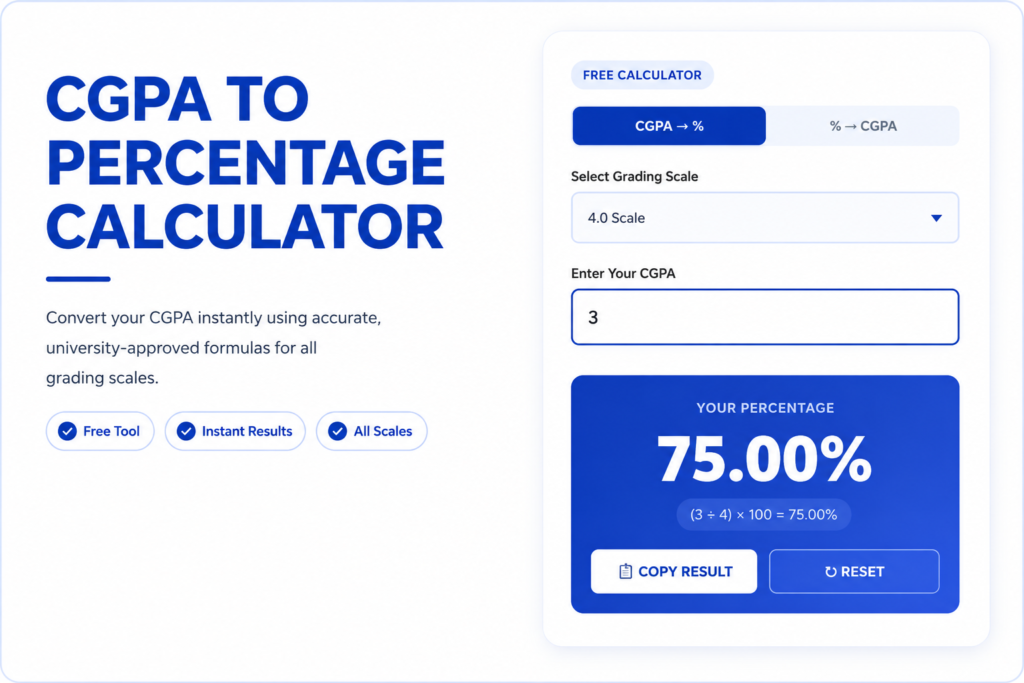
Using CGPA to Percentage Calculator Tool
The easiest method is using an online calculator:
- Enter your CGPA
- Choose grading scale
- Click calculate
- Get instant percentage
Using Simple Conversion Formula
For most 10-point institutions:
Percentage = CGPA × 9.5
Example:
If CGPA = 8.5
Percentage = 8.5 × 9.5 = 80.75%
CGPA to Percentage Conversion Table:
10-Point Scale Conversion Table
| CGPA | Percentage (%) |
|---|---|
| 10.0 | 95.00% |
| 9.9 | 94.05% |
| 9.8 | 93.10% |
| 9.7 | 92.15% |
| 9.6 | 91.20% |
| 9.5 | 90.25% |
| 9.4 | 89.30% |
| 9.3 | 88.35% |
| 9.2 | 87.40% |
| 9.1 | 86.45% |
| 9.0 | 85.50% |
| 8.9 | 84.55% |
| 8.8 | 83.60% |
| 8.7 | 82.65% |
| 8.6 | 81.70% |
| 8.5 | 80.75% |
| 8.4 | 79.80% |
| 8.3 | 78.85% |
| 8.2 | 77.90% |
| 8.1 | 76.95% |
| 8.0 | 76.00% |
| 7.9 | 75.05% |
| 7.8 | 74.10% |
| 7.7 | 73.15% |
| 7.6 | 72.20% |
| 7.5 | 71.25% |
| 7.4 | 70.30% |
| 7.3 | 69.35% |
| 7.2 | 68.40% |
| 7.1 | 67.45% |
| 7.0 | 66.50% |
| 6.9 | 65.55% |
| 6.8 | 64.60% |
| 6.7 | 63.65% |
| 6.6 | 62.70% |
| 6.5 | 61.75% |
| 6.4 | 60.80% |
| 6.3 | 59.85% |
| 6.2 | 58.90% |
| 6.1 | 57.95% |
| 6.0 | 57.00% |
| 5.9 | 56.05% |
| 5.8 | 55.10% |
| 5.7 | 54.15% |
| 5.6 | 53.20% |
| 5.5 | 52.25% |
| 5.4 | 51.30% |
| 5.3 | 50.35% |
| 5.2 | 49.40% |
| 5.1 | 48.45% |
| 5.0 | 47.50% |
| 4.9 | 46.55% |
| 4.8 | 45.60% |
| 4.7 | 44.65% |
| 4.6 | 43.70% |
| 4.5 | 42.75% |
| 4.4 | 41.80% |
| 4.3 | 40.85% |
| 4.2 | 39.90% |
| 4.1 | 38.95% |
| 4.0 | 38.00% |
5-Point Scale Conversion Table
| CGPA | Percentage (%) |
|---|---|
| 5.0 | 100% |
| 4.5 | 90% |
| 4.0 | 80% |
| 3.5 | 70% |
| 3.0 | 60% |
| 2.5 | 50% |
| 2.0 | 40% |
4-Point Scale Conversion Table
| CGPA | Percentage (%) |
|---|---|
| 4.0 | 100% |
| 3.8 | 95% |
| 3.6 | 90% |
| 3.4 | 85% |
| 3.2 | 80% |
| 3.0 | 75% |
| 2.8 | 70% |
| 2.5 | 62.5% |
| 2.0 | 50% |
Difference Between GPA, CGPA and SGPA
Students often confuse GPA, CGPA, and SGPA, but each has a different meaning.
| Term | Full Form | Meaning |
|---|---|---|
| GPA | Grade Point Average | Performance in one subject or one term |
| SGPA | Semester Grade Point Average | Performance in one semester |
| CGPA | Cumulative Grade Point Average | Overall academic performance across all semesters |
Quick Explanation
- GPA = Grade average for one course or subject
- SGPA = Average score for one semester
- CGPA = Average score for the entire degree/program
Converting CGPA to GPA
Many international universities require GPA (4-point scale) instead of CGPA.
Simple CGPA to GPA Conversion Table
| CGPA (10 Scale) | Approx GPA (4 Scale) |
|---|---|
| 10.0 | 4.0 |
| 9.5 | 3.8 |
| 9.0 | 3.6 |
| 8.5 | 3.4 |
| 8.0 | 3.2 |
| 7.5 | 3.0 |
| 7.0 | 2.8 |
| 6.5 | 2.6 |
| 6.0 | 2.4 |
| 5.5 | 2.2 |
| 5.0 | 2.0 |
Accuracy and Reliability of CGPA to Percentage Calculator
A good CGPA calculator provides fast and reliable results, but accuracy depends on:
- Correct CGPA input
- Correct grading scale selection
- University-specific formula usage
- Updated conversion multipliers
Why Use an Online Calculator?
✅ Saves time
✅ Avoids manual errors
✅ Instant conversion
✅ Easy to use
✅ Works for multiple grading systems
Always verify if your university uses a custom formula.
How can I improve my CGPA?

Improving CGPA requires consistent effort and better study habits.
Strategies to Improve Your CGPA
1. Follow a Regular Study Routine
Studying daily helps improve retention and understanding.
Benefits:
- Better memory
- Less exam stress
- Improved performance
2. Focus on Weak Subjects
Identify low-scoring subjects and spend more time improving them.
Tips:
- Watch tutorials
- Ask teachers for help
- Practice extra questions
3. Participate Actively in Class
Students who engage in class discussions usually perform better.
Do this:
- Ask questions
- Take notes
- Stay attentive
4. Practice Mock Tests
Mock exams improve speed and confidence.
Benefits:
- Better time management
- Familiarity with exam patterns
- Reduced anxiety
5. Maintain a Healthy Lifestyle
Academic success also depends on physical and mental health.
Remember to:
- Sleep 7–8 hours
- Eat healthy food
- Exercise regularly
Is Scoring High Marks in Academics Important?
Scoring high marks in academics is important because it plays a major role in shaping a student’s future and personal development. Academic success is not only about getting good grades; it also reflects dedication, hard work, discipline, and the ability to understand and apply knowledge effectively. Strong academic performance can open the door to better educational opportunities, scholarships, and career options. Although marks should not be the only measure of intelligence, they are often considered an important indicator of progress and achievement.

Importance of Academic Achievement in Your Life
Academic achievement affects many aspects of a student’s life, both in the present and in the future. It helps students build confidence, improve learning abilities, and prepare for greater opportunities. Success in academics creates a strong foundation for personal and professional growth.
I. Short-term Benefits of Academic Achievement
One of the biggest short-term benefits of scoring high marks is improved academic standing. Students who perform well often receive better grades, higher class rankings, and recognition from teachers and classmates. Good academic performance can also increase the chances of receiving scholarships and educational rewards. These achievements motivate students to work harder and build confidence in their abilities.
II. Long-term Impact on Future Opportunities
Strong academic performance can greatly influence future opportunities. High marks can improve the chances of getting admission into top colleges and universities, especially where competition is high. Good academic records also help students succeed in competitive exams and make their job applications stronger. Employers often value candidates with excellent academic backgrounds because it shows dedication, responsibility, and the ability to solve problems effectively.
III. Developing Critical Life Skills
Academic success is not only about marks; it also helps students develop important life skills. Regular studying and completing assignments teach discipline, time management, and consistency. Students learn how to think critically, solve problems, communicate effectively, and analyze information carefully. These skills are useful not only in education but also in everyday life and future careers.
IV. Social and Emotional Benefits
Doing well in academics can have a positive impact on a student’s emotional and social well-being. Academic success increases self-esteem and motivation, making students feel proud of their efforts. It can also bring happiness and pride to their families. Students who perform well often gain respect from teachers, friends, and society, which further encourages them to continue improving.
V. Academic Achievement and Personal Growth
Education plays a major role in personal development. Through academic achievements, students become more independent, responsible, confident, and capable. They learn how to set goals, stay focused, and handle challenges. These qualities help shape a stronger personality and prepare students for real-life responsibilities.
VI. Overcoming Challenges in Academic Achievement
Achieving high marks is not always easy, and many students face challenges such as lack of motivation, poor time management, stress, and difficulty understanding certain subjects. However, these obstacles can be overcome by setting clear goals, creating a study plan, asking for support from teachers or tutors, using helpful learning tools, and staying consistent. Persistence and effort are key to academic success.
VII. The Role of Support Systems
Support from others can make a big difference in academic performance. Parents, teachers, friends, tutors, and online learning communities can provide guidance, motivation, and encouragement. A strong support system helps students stay focused, overcome difficulties, and achieve better results.
VIII. Measuring Academic Achievement Beyond Grades
While grades are important, academic success is not limited to marks alone. True achievement also includes skills development, creativity, leadership abilities, practical knowledge, and self-confidence. A well-rounded education helps students grow in many different ways and prepares them for future success.
Conclusion
Academic achievement is an essential part of a student’s journey and can greatly influence future opportunities and personal growth. Whether you are trying to improve your grades, understand your CGPA, or convert CGPA into percentage, staying committed to learning and using effective study strategies can lead to better academic results. By focusing on both grades and skill development, students can unlock greater confidence, stronger abilities, and a brighter future.
FAQs
1. How to calculate CGPA percentage?
Multiply your CGPA by the standard conversion factor (usually 9.5).
2. What is the formula for converting CGPA to a percentage?
Percentage = CGPA × 9.5
3. How accurate is the CGPA to Percentage calculator?
Very accurate, if the correct grading scale and formula are used.
4. How does the CGPA grading scale work?
Each subject receives grade points, and the average becomes your CGPA.
5. Can the CGPA to Percentage conversion vary between institutions?
Yes. Different universities may use different formulas.
6. What is the standard multiplier used in CGPA to Percentage conversion?
The most common multiplier is 9.5.
7. How does a CGPA of 10 convert to a percentage?
Usually 95% to 100%, depending on institution rules.
8. Is there a difference between the 4.0 and 10.0 grading scales in CGPA?
Yes. Both use different maximum values and conversion formulas.