SGPA TO CGPA
CALCULATOR
Calculate your CGPA from semester-wise SGPA & credits, or convert your SGPA to percentage using accurate, university-approved formulas for all grading scales.
Why Students Choose Us
No sign-up required. Just fast, accurate results using university-approved formulas.
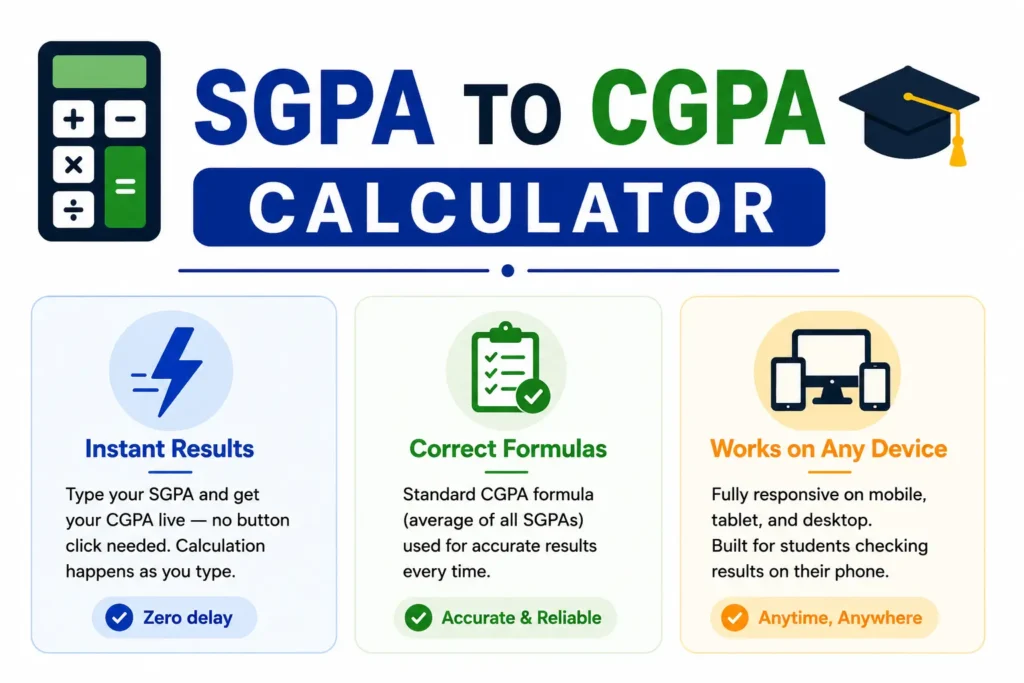
Instant Results
Type your CGPA and get your percentage live — no button click needed. Calculation happens as you type.
Zero delayCorrect Formulas
Standard CBSE formula (×9.5) for 10-point scale. Accurate formulas for 5-point and 4-point scales too.
Formula shown on resultWorks on Any Device
Fully responsive on mobile, tablet, and desktop. Built for students checking results on their phone.
Mobile firstSGPA to CGPA and SGPA to Percentage: The Complete Guide for Students
If you’ve just gotten your semester result and you’re staring at a number labeled “SGPA,” wondering what it actually means for your overall CGPA or your percentage, you’re not alone. Almost every student runs into this confusion at some point — usually right when a scholarship form or a job application is asking for a percentage figure and all you have is a grade point.
This guide walks through exactly what SGPA, CGPA, and percentage mean, how they relate to each other, how to convert between them with simple, practical examples, and where students typically go wrong while doing it manually.
What Is SGPA?
SGPA stands for Semester Grade Point Average. It’s a single number that sums up how you performed in one semester, based on the grades you earned in each subject and the credit weight assigned to that subject.
Here’s the basic idea: not every subject counts equally. A lab-heavy subject with 5 credits pulls more weight in your SGPA than an elective worth 2 credits. So your SGPA isn’t just “average of all my grades” — it’s a credit-weighted average.
Formula:
SGPA = (Sum of [Grade Point × Credits] for each subject) ÷ (Total Credits for the semester)
For example, if you took four subjects:
| Subject | Grade Point | Credits | Grade Point × Credits |
|---|---|---|---|
| Maths | 9 | 4 | 36 |
| Physics | 8 | 4 | 32 |
| Programming | 9 | 3 | 27 |
| English | 7 | 2 | 14 |
Total grade points = 36 + 32 + 27 + 14 = 109 Total credits = 4 + 4 + 3 + 2 = 13
SGPA = 109 ÷ 13 = 8.38
This is the number that shows up on your semester report card, and it’s the building block for everything else in this guide — your CGPA and your percentage are both derived from it.
What Is CGPA?
CGPA stands for Cumulative Grade Point Average. While SGPA only measures your academic performance in one semester, CGPA reflects your overall performance across all the semesters you have completed so far. It is commonly used by universities to evaluate a student’s academic progress. If you want to convert your CGPA into a percentage, a CGPA to Percentage Calculator can help you quickly calculate the equivalent percentage using the appropriate conversion formula.
There are two common ways universities calculate CGPA from SGPA:
Method 1: Simple Average (when every semester carries equal credits)
CGPA = (SGPA of Sem 1 + SGPA of Sem 2 + ... + SGPA of Sem n) ÷ Number of Semesters
Example: Suppose your SGPAs across four semesters are 8.0, 8.5, 7.8, and 8.7.
CGPA = (8.0 + 8.5 + 7.8 + 8.7) ÷ 4 = 33.0 ÷ 4 = 8.25
Method 2: Credit-Weighted Average (more accurate, used when credits vary by semester)
CGPA = (Sum of SGPA × Credits for each semester) ÷ Total Credits across all semesters
Example: Say your semesters had different credit loads.
| Semester | SGPA | Credits | SGPA × Credits |
|---|---|---|---|
| 1 | 8.5 | 24 | 204.0 |
| 2 | 7.8 | 26 | 202.8 |
| 3 | 9.2 | 22 | 202.4 |
| 4 | 8.1 | 25 | 202.5 |
Total = 811.7, Total Credits = 97
CGPA = 811.7 ÷ 97 = 8.37
Notice that Semester 3 had the highest SGPA (9.2) but didn’t pull the CGPA up as much, simply because it carried fewer credits. This is exactly why credit-weighted calculation gives a more honest picture than simple averaging — and why you should always check which method your university actually follows before trusting a quick manual estimate.
SGPA vs CGPA: The Core Difference
It helps to think of it this way:
- SGPA is a snapshot — it tells you how one semester went.
- CGPA is the full picture — it tells you how your entire academic journey is going.
A rough semester won’t permanently damage your CGPA, because future semesters can pull the average back up. That’s also why universities, recruiters, and scholarship committees lean on CGPA rather than SGPA when judging overall academic standing — one bad semester says little, but a consistent CGPA across multiple semesters says a lot.
There’s also a difference in how each number is used day to day. SGPA is what you check right after results are declared — it tells you whether this particular semester’s effort paid off, and it’s useful for spotting subjects or patterns that need attention before the next semester starts. CGPA, on the other hand, is what gets pulled out months or years later: when you’re applying for an internship, filling a higher-education form, or sitting for a campus placement interview. Nobody asks for your third-semester SGPA in a job application — they ask for your CGPA, because it represents sustained performance rather than a single data point.
How Universities Calculate CGPA Differently
One thing that trips up a lot of students is assuming every university follows the exact same rulebook. They don’t. Broadly, you’ll come across a few patterns:
Equal-weight averaging. Some universities, particularly ones where every semester has roughly the same total credit load, simply average the SGPAs together. This is the simplest method and the one most online calculators default to when credit information isn’t provided.
Credit-weighted averaging. This is more common in technical and engineering programs where credit loads shift from semester to semester — for instance, a semester with a major project or thesis component often carries more credits than a semester with mostly theory subjects. Here, CGPA is computed strictly through the SGPA × Credits method described above.
Grade-point-based averaging without going through SGPA at all. A few universities skip the SGPA step entirely for the official transcript and calculate CGPA directly from every individual subject’s grade point and credit value across all semesters combined. The result is usually very close to what you’d get by averaging SGPAs, but not always identical, especially if you’ve repeated a course or had it graded under a different policy.
If you’re an engineering or technical student, this distinction matters even more. Programs in this category typically include theory courses, lab courses, mini-projects, electives, and sometimes internships — all carrying different credit values. A subject with 5 credits will influence your final CGPA more than one with 2 credits, so improving performance in your higher-credit courses generally has a bigger payoff than chasing a perfect score in a low-credit elective.
How to Convert SGPA to Percentage
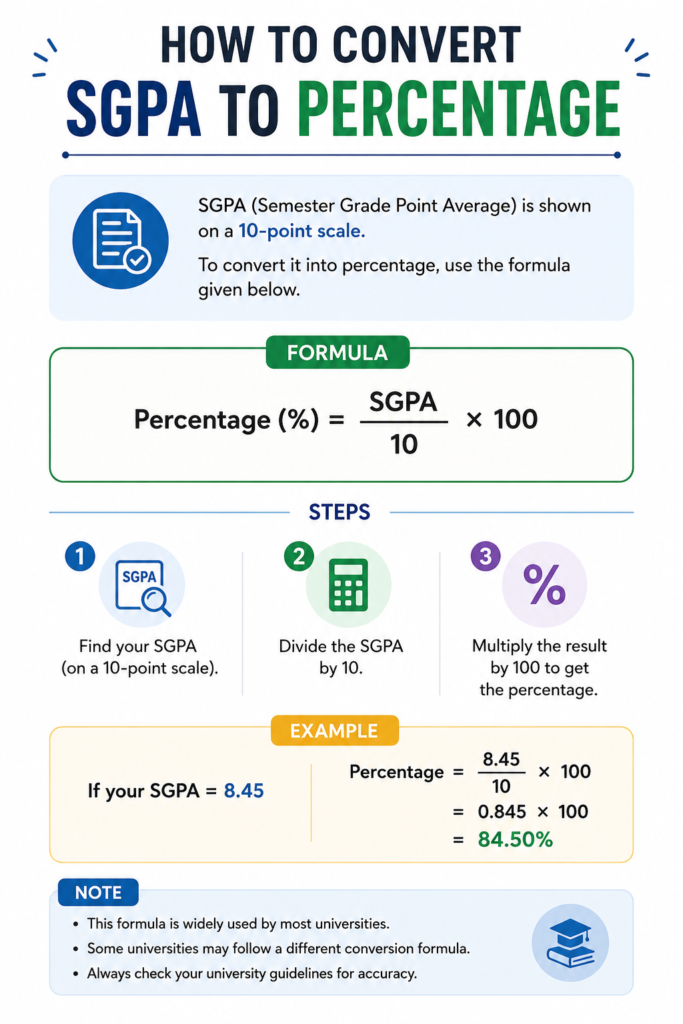
Once you know your SGPA (or CGPA), converting it to a percentage is often necessary for job applications, study-abroad forms, or scholarships that ask for percentage marks instead of grade points.
There’s no single formula that works for every university — conversion multipliers differ by institution — but the most widely used formula, especially in India’s 10-point grading system, is:
Percentage = SGPA × 9.5
Example:
If your SGPA is 8.4:
Percentage = 8.4 × 9.5 = 79.8%
Some institutions use a slightly different multiplier (9.0, 9.5, or 10, depending on their grading policy), and a few ask you to convert SGPA to CGPA first and only then to percentage. Always cross-check with your university’s official conversion chart before submitting any document, since an approximate calculator result should never replace your institution’s own conversion table for official purposes.
It’s also worth knowing that this 9.5 multiplier isn’t a universal mathematical law — it’s a convention that became common because many Indian universities adopted it as a rough equivalence between a 10-point CGPA and a 100-point percentage scale. Universities outside this system, including many in the US, Canada, and Europe, don’t use a multiplier-based percentage conversion at all; they work directly with GPA scales (commonly 4.0) and rarely need to express results as a percentage for official purposes. So if you study abroad or your institution follows international norms, you may find that asking “what’s my SGPA in percentage” doesn’t even apply the way it does on a 10-point scale.
Quick Reference Table
| You Have | You Want | Formula |
|---|---|---|
| Subject grades + credits | SGPA | (Grade Point × Credits) ÷ Total Credits |
| SGPA of all semesters (equal credits) | CGPA | Sum of SGPAs ÷ Number of Semesters |
| SGPA of all semesters (different credits) | CGPA | (SGPA × Credits) ÷ Total Credits |
| SGPA or CGPA | Percentage | SGPA/CGPA × 9.5 (verify your university’s multiplier) |
A Worked Example From Start to Finish
To tie everything together, let’s walk through one complete scenario the way a student would actually experience it across a degree program.
Suppose you’re in your fourth semester and want to know your current CGPA and its percentage equivalent. Your semester-wise SGPA and credits look like this:
| Semester | SGPA | Credits |
|---|---|---|
| 1 | 7.6 | 22 |
| 2 | 8.1 | 24 |
| 3 | 7.9 | 23 |
| 4 | 8.6 | 25 |
Step 1 — Calculate weighted points per semester:
- Sem 1: 7.6 × 22 = 167.2
- Sem 2: 8.1 × 24 = 194.4
- Sem 3: 7.9 × 23 = 181.7
- Sem 4: 8.6 × 25 = 215.0
Step 2 — Add the weighted points:
167.2 + 194.4 + 181.7 + 215.0 = 758.3
Step 3 — Add the total credits:
22 + 24 + 23 + 25 = 94
Step 4 — Divide to get CGPA:
758.3 ÷ 94 = 8.07
Step 5 — Convert to percentage:
8.07 × 9.5 = 76.66%
So after four semesters, this student’s CGPA is 8.07, translating to roughly 76.66% — a number they could now confidently put on a resume or scholarship application, while still mentioning the original CGPA for academic purposes since most institutions prefer CGPA on official transcripts.
Common Mistakes to Avoid
A few errors show up again and again when students calculate these values by hand:
Ignoring credit weightage. Treating every semester or subject as equally important when your university actually uses a credit-weighted system will throw off your final number. This is by far the most frequent mistake, since simple averaging feels more intuitive even when it isn’t the correct method for your institution.
Mixing up SGPA and CGPA. Remember — SGPA is per semester, CGPA is cumulative. Plugging one into a formula meant for the other gives a misleading result, and this confusion is especially common among first- and second-year students who haven’t yet seen enough semesters to notice the difference clearly.
Using the wrong percentage multiplier. Not every university uses 9.5. Some use different conversion factors entirely, so don’t assume one formula applies everywhere — particularly if your institution follows a grading policy that isn’t based on the standard 10-point scale.
Rounding too early. Round only your final answer. Rounding intermediate numbers (like grade points per subject, or SGPA before multiplying by credits) can compound into a noticeably wrong CGPA or percentage by the end, especially across six or eight semesters where small errors accumulate.
Forgetting about backlog or repeated subjects. If you’ve failed a subject and retaken it, your university’s policy on whether to use the original grade, the latest grade, or the best grade can significantly change your CGPA. Always confirm this policy rather than assuming the most recent attempt automatically replaces the older one in every calculation.
Treating an online calculator’s result as final for official documents. Calculators are excellent for quick estimates and tracking your own progress, but for anything submitted officially — transcripts, scholarship forms, job applications — your university’s own conversion table or registrar’s office is the authoritative source.
Why Keeping Track of Your CGPA Matters
Beyond just satisfying curiosity after each semester, there are real, practical reasons to monitor your CGPA consistently rather than only checking it once a year:
Scholarship eligibility. Many merit-based scholarships set a minimum CGPA cutoff, and missing it by a small margin because of an avoidable calculation mistake or an unmonitored dip can cost you funding you’d otherwise qualify for.
Placement and recruitment filters. A number of companies, especially larger ones with high application volumes, use CGPA as an initial screening filter before even reviewing a resume in detail. Knowing where you stand lets you address weak areas before recruitment season arrives rather than discovering the cutoff issue too late.
Higher education applications. Postgraduate programs, whether in your home country or abroad, frequently ask for CGPA alongside standardized test scores. International applications in particular may also require a percentage equivalent, which is where SGPA-to-percentage conversion becomes practically useful rather than just academic curiosity.
Early course correction. If your SGPA dips in one semester, catching it immediately — rather than waiting until graduation to “do the math” — gives you the chance to adjust study habits, seek help in specific subjects, or rebalance your course load before the dip becomes a long-term trend.
Tips to Improve Your CGPA Over Time
If your current CGPA isn’t where you’d like it to be, the encouraging news is that it’s rarely too late to improve it meaningfully, especially if you still have several semesters remaining.
Focus on high-credit subjects first. Since these carry more weight in both your SGPA and CGPA, even a modest improvement in a 4 or 5-credit subject moves your overall average more than the same improvement in a 1 or 2-credit elective.
Don’t let one bad semester define your strategy. A single low SGPA, especially early on, has less impact on your final CGPA than most students assume, because it gets averaged against many future semesters. Treat it as a signal to adjust, not a verdict on your overall academic ability.
Stay consistent rather than chasing one perfect semester. Small, steady improvements semester after semester compound more reliably than trying to dramatically overperform in just one term to compensate for past results.
Understand your university’s exact policies early. Whether it’s the rounding method, the treatment of repeated subjects, or the specific percentage multiplier used, knowing these details in advance means fewer surprises when your final transcript is issued.
Final Thoughts
SGPA, CGPA, and percentage all measure the same underlying thing — your academic performance — just viewed at different scales: one semester, your whole course, or a familiar 100-point format. Once you understand how credits factor into the calculation, converting between them becomes straightforward, whether you’re doing it by hand or just double-checking what a calculator gave you.
Manual calculation is useful for understanding the logic, but it’s easy to make small errors, especially across multiple semesters with varying credit loads. That’s exactly the kind of repetitive, detail-heavy task an online calculator handles faster and more reliably than doing it by hand every time.
If you’d rather skip the manual math, use our SGPA to CGPA Calculator and SGPA to Percentage Calculator above — just enter your semester SGPA and credits, and get an instant, accurate result you can rely on for tracking your progress throughout your degree.
FAQs
1. What is the difference between SGPA and CGPA?
SGPA is your grade average for one semester, while CGPA is the cumulative average across all semesters so far.
2. How do I convert SGPA to CGPA?
Average all your SGPAs if credits are equal each semester, or use a credit-weighted average if credits vary.
3. What is the formula to convert SGPA to percentage?
The common formula is Percentage = SGPA × 9.5, though the multiplier can vary by university.
4. Is CGPA always higher than SGPA, or can it be lower?
Neither is fixed — CGPA simply moves up or down depending on whether the latest SGPA is above or below it.
5. Can my CGPA decrease even if my SGPA improves?
Yes, if the improved SGPA is still below your current CGPA or carries relatively low credits.